
My opening question was straightforward: where does Tlaxcala stand in technology and artificial intelligence? I work with software and use AI as a tool, but looking at my own state, I found it difficult to assemble a concrete picture of what is happening here.
I started looking through data and schools. I wanted to know what options exist for someone here choosing what to study, and what they might do with what they learn. I found several things worth sharing.
This is the first part of that search, a starting point for sharing discoveries and returning to projects worth following.
Before looking for AI, I looked at how people reach it
I began with internet access. When a tool needs connectivity to function, access becomes part of its story.
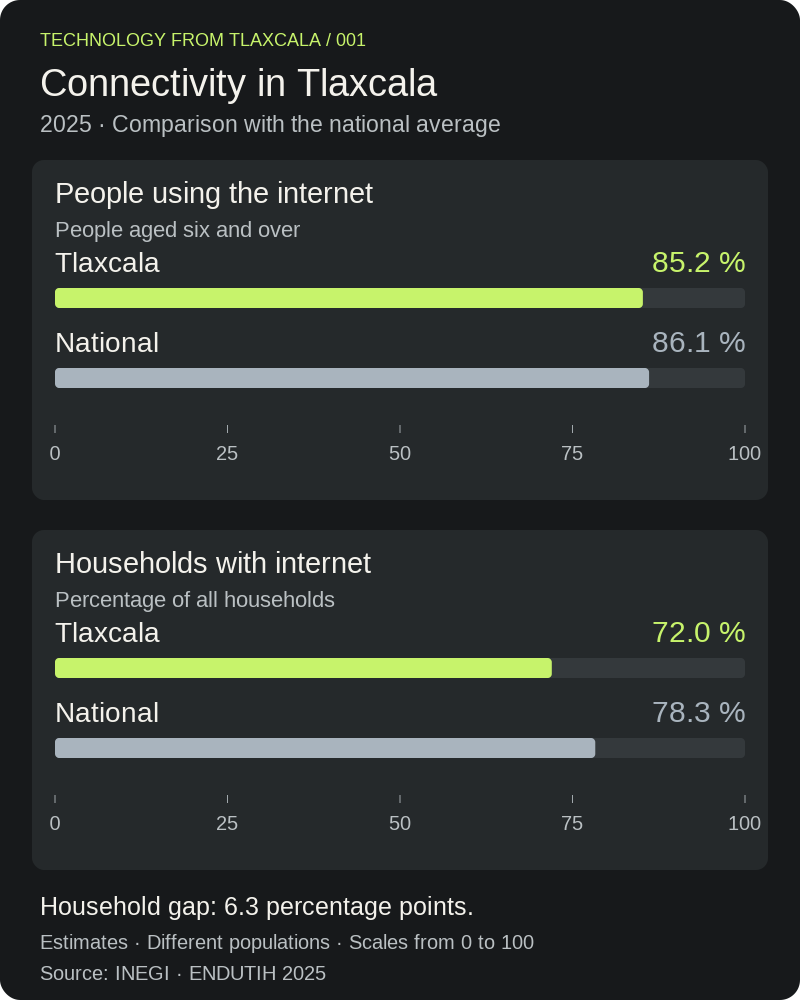
ENDUTIH 2025 puts internet use in Tlaxcala at 85.2% of people aged six and over. At household level, 72% had access, compared with 78.3% nationally. INEGI published these results in 2026.
TLAXCALA / 2025
85.2 %
People using the internet · People aged six and over
0.9 percentage points below the national estimate.
TLAXCALA / 2025
72.0 %
Connected households · Of all households
6.3 percentage points below the national estimate.
How to read these figures
People and households are different populations. Each comparison uses a 0–100 scale and matching state and national indicators. The gap is calculated from estimates; it neither explains its causes nor measures AI use.
What caught my attention was the change in perspective. One figure describes people using the internet; the other describes households with access. Subtracting one from the other cannot tell us how many people are disconnected, because the populations differ.
Comparing households with households, Tlaxcala sits 6.3 percentage points below the national estimate. That gap does not establish its causes or describe each connection’s quality. It does raise a useful question: under what conditions can people reach a digital solution?
I thought of something as ordinary as resolving a class question on a phone. A system can hold a good answer and still be difficult to use if the page downloads too much, its text is unclear or a failed request forces someone to start again.
That is familiar territory for me as a developer. Between a system existing and someone benefiting from it sit specific decisions: how much it downloads, how information is organized and what it communicates while waiting. Connectivity matters differently when viewed through that journey.
I found more than one way into this
The Unidad Profesional Interdisciplinaria de Ingeniería Campus Tlaxcala (“UPIIT”), part of Instituto Politécnico Nacional, offers Artificial Intelligence Engineering and a bachelor’s degree in Data Science. That seems worth exploring if you enjoy maths, spotting patterns or understanding why something happens through numbers. You could start by analysing sales and stock to anticipate shortages, or exploring transport data to identify busy times. Those problems come up in retail, logistics and industry.
There are already examples of where that combination can lead. In February 2026, Microsoft described how Cemex uses LUCA Bot: an agent its executives use to ask questions about financial information. Data, software and AI come together to meet a need at a Mexican company.
Universidad Politécnica de Tlaxcala (“UPTlax”) offers a degree in Information Technology and Digital Innovation Engineering, alongside TSU options in AI, Data Science and Digital Networks. If building applications or understanding how systems connect appeals to you, those paths are worth exploring. Think of a platform for a local business: it needs screens, organised information and a network that makes it usable. Depending on what you enjoy building, you might lean towards development, data or infrastructure. TSU and bachelor’s degrees are different qualifications, so check each path carefully.
I also found a project that makes the industrial side easier to picture. Marco Antonio Morales Caporal and Ivette Hernández-Dávila presented computer-vision work on detecting cracks in ceramic tiles at RED COMPA on May 20–21, 2026. That makes the subject tangible: teaching a system to recognise a defect in an image could have a quality-control application. The announcement does not yet provide accuracy figures or evidence of factory deployment.
Universidad Autónoma de Tlaxcala (“UATx”) offers a bachelor’s degree in Artificial Intelligence whose 2025 curriculum includes Python, neural networks, image processing and ethics. If you enjoy programming, experimenting and understanding how a model learns, those subjects could appeal to you. Programming and maths will be part of the journey.
What interests me is how that knowledge can meet other interests. If you also enjoy biology, take AlphaFold: EMBL-EBI reported in October 2025 that its database contained predicted structures for over 200 million proteins. It is an international example of AI applied to biological research. Seeing cases like that makes a degree feel more concrete than a list of subjects: I begin to imagine what someone could do with them.
Where people learn. What lies behind it.
Open each institution to explore its programmes and linked evidence.
01Politécnico Nacional
AI Engineering and a bachelor’s degree in Data Science
Programmes ↗ · Politécnico NacionalFaculty directory ↗ · Politécnico Nacional
02Universidad Politécnica
IT and Digital Innovation Engineering; TSU programmes in AI, data and networks
Programmes ↗ · Universidad PolitécnicaResearch presented in May 2026 ↗ · Universidad Politécnica
03Universidad Autónoma
Bachelor’s degree in Artificial Intelligence · 2025 curriculum
Programmes ↗ · Universidad AutónomaJune 2026 colloquium and workshop ↗ · Universidad Autónoma
I also found lecturers building interesting things
At the Politécnico Nacional I found a 2026 paper on recommending mathematics content using natural language processing, co-authored by Daniel Sánchez Ruiz and other researchers. The research explores adapting language models to that content and to Spanish. I liked seeing an application close to any student’s experience: finding support to understand a subject. If programming and education interest you, that combination is worth exploring.
A 2025 study co-authored by Leticia Flores Pulido from Universidad Autónoma also caught my attention. It applies neural networks to stellar light curves, records of how stars’ brightness changes, using Kepler data. I liked finding that connection with astronomy in a local researcher’s work. She also received Candidate recognition in the 2025 SNII call.
At Universidad Politécnica, Morales Caporal also helped deliver internal training on AI applied to teaching on August 24–28, 2026. That is the same researcher behind the ceramic-tile project. It interests me that he works on an industrial application and also shares tools with other lecturers. And in June 2026, Universidad Autónoma held a colloquium including the PromptLab workshop, another way to bring these tools to its community.
There is still more to discover
I started out curious about my state and ended up finding options I would have liked to know about when choosing what to study. If one caught your attention, you could start with its curriculum and its lecturers’ projects. Sometimes discovering a specific application makes it easier to recognise what you enjoy than reading a degree title.
Sources consulted on November 13, 2026. Internet figures refer to 2025; local academic work and activities to 2025 and 2026; SNII recognition to 2025. Cemex and AlphaFold are external reference cases. Check each institution’s admissions announcements for upcoming applications.
AN IDEA TO SHARE