
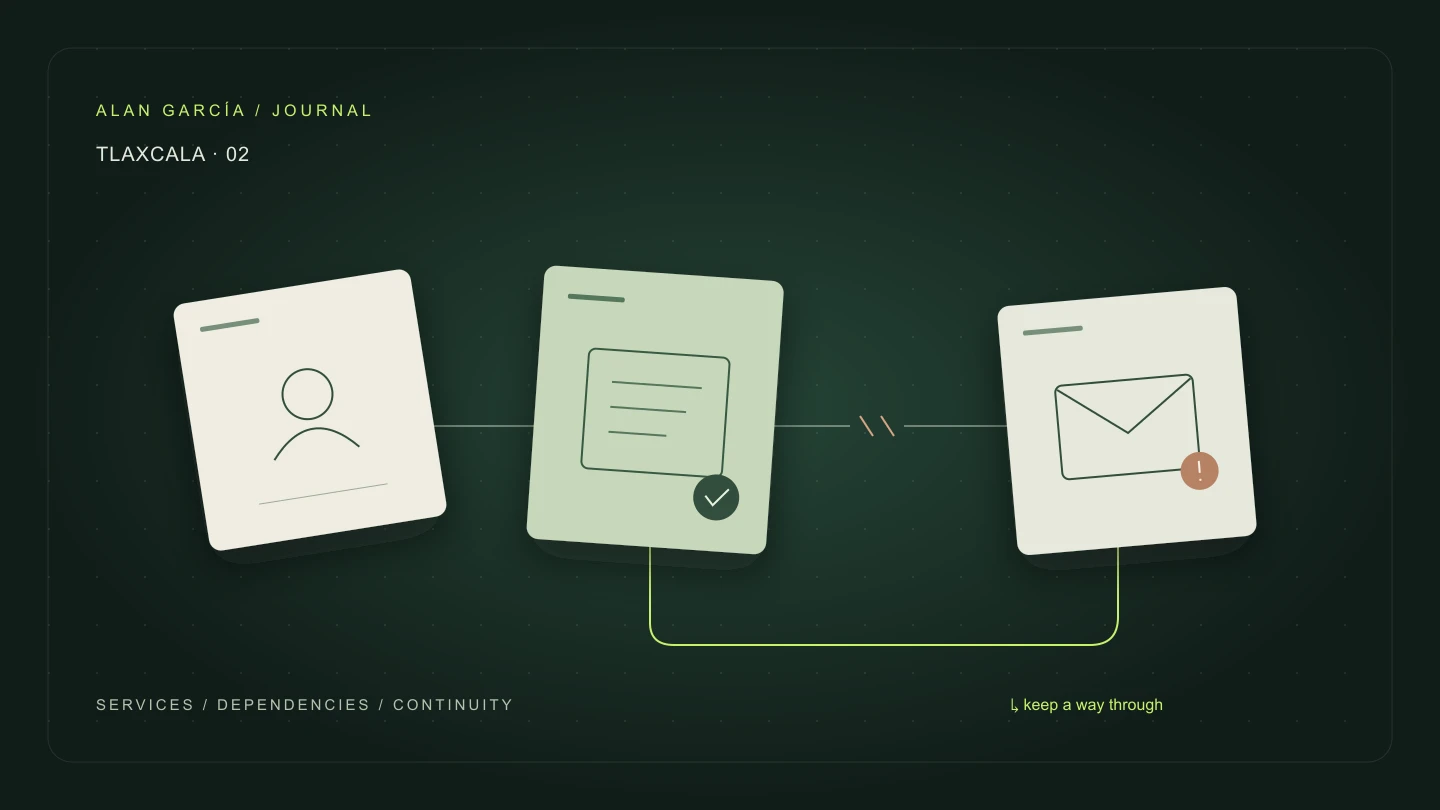
After looking at technology education in Tlaxcala, I kept thinking about the other side of the story: the systems we already use. The ones behind an email, an appointment, a payment, or a task we expect to complete from our phones.
I usually have no reason to know how they are built. I open the service, finish what I need to do, and get on with my day. When it stops responding, though, a less comfortable question appears: what part of my day was depending on this, and what can I do until it comes back?
The Microsoft interruption in November made me look more closely at that journey. I wanted to understand what happened, what effects were documented in Mexico, and what I could find about services used in Tlaxcala. As I read, the question became about more than why a platform went down. I also started wondering how a service prepares to keep helping people when something fails.
A distant failure can feel quite close
On November 12, 2026, ThousandEyes observed global availability problems affecting Microsoft 365. The next day, recovery still varied between locations. Its outage analysis tracks the incident beyond the reports appearing on social media.
Microsoft’s preliminary explanation described network changes exposing a latent bug: requests accumulated until servers lacked capacity for new connections. It also distinguished restored access from processing the email backlog. These details appear in Microsoft updates reproduced by the University of Pennsylvania. The record now announces a post-incident report, but that announcement does not display the complete document.
There is a concrete Mexican example. The National Customs Agency of Mexico, or ANAM, published a notice linking intermittent operation to the Microsoft failures. La Jornada reported on November 12 that the agency clarified operations had been handled with support and that its notice was preventive.
That distinction matters to me. Intermittent operation can complicate a process without meaning an entire institution has stopped. Combining the two makes for a more alarming, less useful story. I also have no figure that would turn that notice into an estimate of financial losses or people affected.
What stays with me is the distance between the origin of a failure and the person encountering it. Someone trying to finish a task has no reason to know about a provider’s network changes. They just know something that should work has stopped, while their unfinished business is still there.
There is more than one system behind the button
It is easy to picture a website as one application. But a journey may need several pieces: identifying a person, retrieving information, validating documents, recording a transaction, and sending confirmation. Each step raises a different question when an error appears.
Was the request never submitted, or was it submitted without a response appearing? Was the payment declined, or has its status not been updated? Did the email fail because the operation failed, or is only the notification pending? On a screen, several of these problems can look exactly alike.
I prepared this diagram to separate those pieces. It is a conceptual example, not the verified architecture of a government portal. Connections and their order can differ between services.
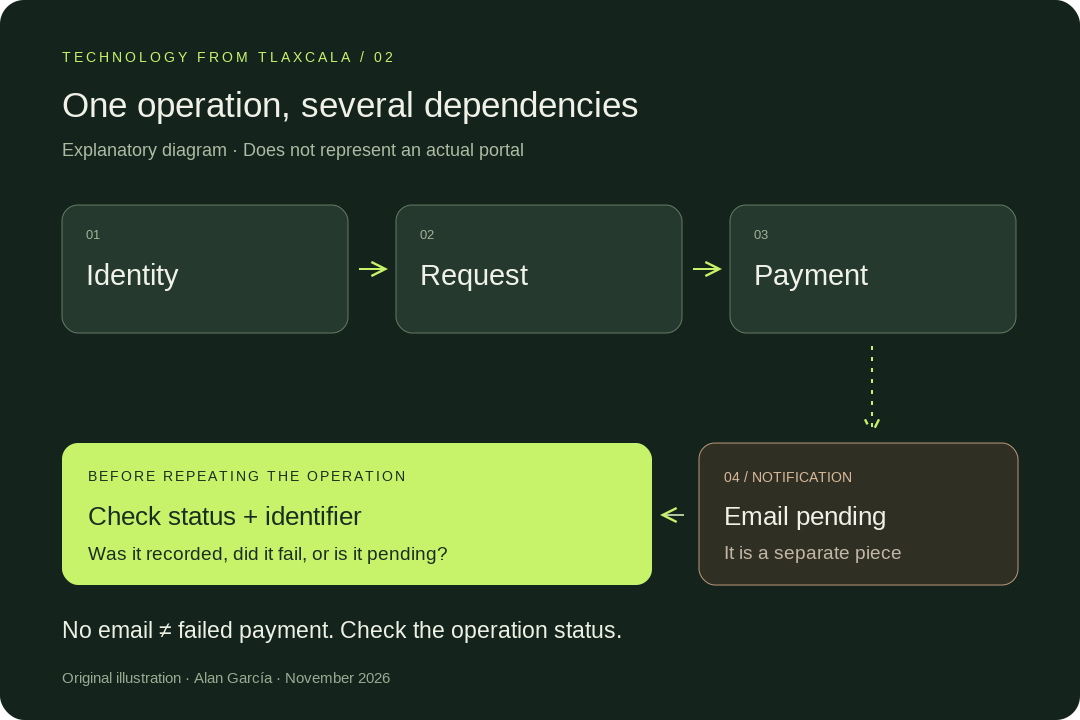
As a developer, I find an interesting design problem here. If the only sign of success is an email, what does the person see when that message is delayed? I would want them to be able to check the operation’s status using an identifier, without having to infer it from an inbox. That is a proposal for thinking through the journey, not a description of what these portals currently do.
It also changes how I investigate. An institution using a Microsoft product does not automatically identify its hosting, its databases, or the cause of every error. Connecting two incidents requires evidence about the affected system and the time of the event, rather than a brand they happen to share.
I looked at services closer to home
In Tlaxcala, I found a concrete starting point: the Finance Secretariat’s frequently asked questions direct vehicle renewal and ownership-tax payments to Tlaxcallan Virtual. The page also points there for a certificate confirming a person is not disqualified from public employment. These tasks have consequences beyond the screen: an obligation to meet or a document someone needs to present.
Digitization had already reached a meaningful scale before November’s incident. A state government release from April 2025 reported 53,497 digital vehicle transactions and 26 million pesos collected between January and April that year. These are historical government-reported figures, not 2026 activity or losses caused by an interruption.
That helps me understand why looking at the complete service matters. I care about a process saving someone a trip, but also about it explaining what to do if it stops halfway through. Someone may have arranged their day around finishing it and may not have time to keep trying.
While looking for the responsibilities behind these pieces, I found that the Financial IT Directorate lists systems administration, infrastructure management, and availability among its functions. The page also addresses information backup and safeguarding. This identifies published responsibilities; it does not tell me how well they are fulfilled or actual recovery times.
In the sources I could consult, I found no verifiable evidence that Tlaxcallan Virtual or Tlaxcala’s vehicle procedures were interrupted by the Microsoft outage on November 12. I could not confirm their current architecture either. Filling those gaps by assuming a particular cloud provider or a shared failure would be inaccurate.
At this point there are two different things: local services that exist, and a local impact I cannot assert. Keeping that distinction is part of making this research useful.
A federal service is also part of life here
The next connection appeared when I looked at Mexico’s tax authority, the SAT. Its guide to changing an address through the Virtual Office describes a journey involving CitaSAT, an email confirmation, and a Microsoft Teams session.
That identifies a dependency in one part of the service. It does not establish that CitaSAT is hosted on Azure or that any particular appointment failed in November. Knowing which part is documented is more useful to me than assigning a technology label to the whole process.
With the IMSS, I found another everyday need: its Digital Medical Appointment guide explains that the application allows people to book with their family doctor for themselves and their beneficiaries using CURP and email. The guide does not identify the application’s hosting or establish an impact from this incident.
Although these are federal systems, people use them from Tlaxcala. For someone seeking assistance, administrative boundaries matter less than completing the journey. That is why I want to look at what information a person receives when one step fails and how they can return to what they were doing.
I think, for example, about an appointment that appears to be recorded but whose email never arrives. As a design scenario, I would want a checkable status, a clear explanation, and an official channel for clarification. I am not describing an event at the IMSS or SAT: it is the kind of situation I would use to review a service before considering it finished.
Recovery is part of the design too
So far, everything might seem to depend on infrastructure. But decisions in the interface and the code can also help during an interruption.
One is avoiding uncontrolled retries. Microsoft’s documentation on retry storms explains that excessive attempts can overload a recovering service. It recommends limits and increasing delays. For me, the visible consequence is straightforward: a screen should not trap someone in a loop that never explains what is happening.
Another is knowing when to temporarily stop calling a failing dependency. The Circuit Breaker pattern describes that behavior. It does not fix the provider, but it helps control how an application responds to the failure.
If I were reviewing a transaction, I would start with three situations: failure before submission, during an operation, and after it has been recorded. I would want to see what state is preserved, how it can be checked, and what guidance the person receives in each case. Those are more concrete questions than simply asking for a website that never goes down.
I would also review alternative routes. Publishing a phone number is not enough if the person answering needs the same unavailable system. An alternative should explain what it can resolve during the disruption, what remains pending, and how follow-up works. That capability needs to be checked, not assumed.
Backups deserve the same attention. I would ask when recovery was last tested and what the result was. A stored copy addresses one part of the problem; returning to operation with it addresses another. For public scrutiny, I would be interested in aggregate results and service commitments, without needing sensitive details to be exposed.
I want to keep looking at what happens after an error
I started by reading about a global outage and ended up thinking about something quite close: the trust we put in a button when something important is waiting behind it.
Digitization can save us a lot of time. I want that progress to include the less visible work: acknowledging a failure, explaining its scope, preserving what we have already done, and helping us continue. It is a way of respecting the time of the person on the other side.
Questions remain about current providers, recovery exercises, and documented incidents involving local services. I would rather leave those open than present an imagined architecture as a finding.
For now, I am keeping an idea I can also bring to my work: I understand a service better when I watch how it responds after something goes wrong. That reveals how much thought went into the person who still needs to finish their task.
Sources reviewed on November 16, 2026. This research distinguishes documented incidents, historical information, and design scenarios; it does not attribute specific impacts to Tlaxcala without evidence.
AN IDEA TO SHARE