My mother was sharing articles, videos, and reels with me about all kinds of theories: from invasions to an alleged blackout caused by an artificial intelligence system that had gone out of control. Each post offered a different version of what was going to happen.
That was one of the reasons I wrote about the alleged worldwide blackout on November 17, 2026. The topic was already part of a family conversation. Throughout the day, I checked news, official notices, and forecasts to understand claims that electricity, internet access, and other services would stop working for 72 hours. I found no verifiable evidence supporting that scenario. I did find a real event and several pieces of information that, when combined, seemed to tell a different story from their sources.
As the day went on, I returned to the sources to see what had changed. By the afternoon, I could confirm that the US emergency alert test had taken place. That helped me follow the story beyond the announcements and see what was known after the exercise.
There was a real event behind the date
The FCC’s Emergency Alert System reporting page confirmed that FEMA conducted the nationwide test on November 17 at 2:20 p.m. Eastern: 1:20 p.m. in Tlaxcala. Participants still had to submit data about receiving the message, so the overall picture of how it worked was still to come.
The US National Weather Service notice describes a message distributed through television and radio. The Maryland emergency management reminder clarifies that this edition did not include wireless alerts to phones. Briefly interrupting programming to carry a message is a different operation from disconnecting electricity or internet access.
Reading those notices gave the date a concrete explanation. There was an announced exercise and programming that would pause to carry a message. What was missing was the supposed shutdown of services in other countries that the posts described.
The Simpsons coincidence adds another layer. EFE Verifica documented that the episode used in posts dates from 2023 and that its November 17 entry does not establish the year 2026. A date in a story can attract attention; turning it into a prediction requires something the scene itself does not provide.
I thought about the different versions my mother had shared. Add a convincing voice, striking images, and an urgent tone to a real date, and a story can seem more solid than it is. Seeing several similar videos does not tell me whether they come from different sources or repeat the same claim.
The 72 hours and the Sun became part of the same story
As I kept reading, I wanted to understand where the 72 hours came from. I found European Commission guidelines dated October 30, 2026, and transmitted to the Council on November 3. They discuss households covering essential needs for at least 72 hours during different crises. They continue a strategy introduced in 2025; they do not identify November 17 as the date of a catastrophe.
The recommendation makes sense to me: having what is needed to get through a few days if an emergency interrupts everyday services. The documents were recent too. The problem appeared when that preparedness became supposed confirmation that something would happen that Tuesday. In what I read, the date was not tied to an announced catastrophe.
Later, I checked solar activity again, another explanation attached to the rumor. The NOAA data for 6:15 p.m., Tlaxcala time, showed G0: no geomagnetic storm in that reading. The three-day forecast included periods of G1, minor intensity. These described what had been observed and what might follow, without outlining a worldwide blackout scenario.
The official NOAA scales distinguish geomagnetic storms from radio disruptions caused by solar activity. And NASA explains that space weather can affect technological systems. That real risk does not justify attributing every failure to it or extrapolating a minor forecast into a worldwide blackout.
That is how I started organizing the pieces: what each source described and what was being taken for granted when it was shared. This diagram helps me see them together while keeping that distinction.
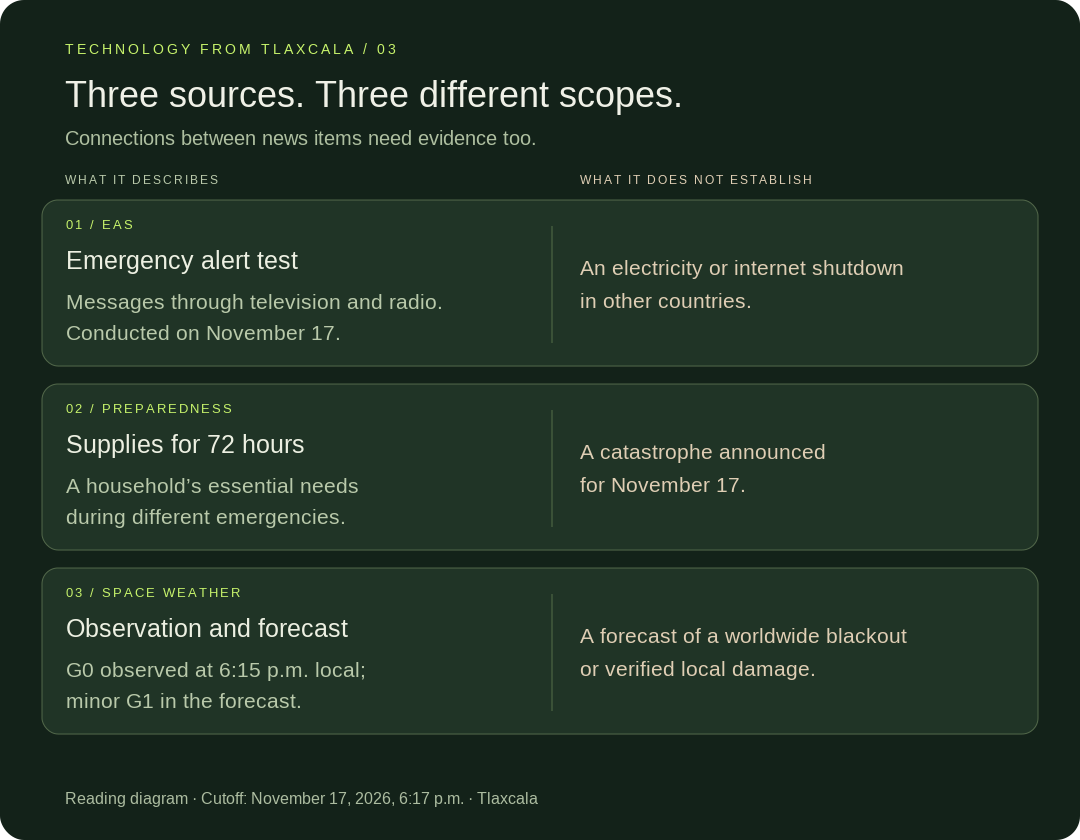
At that point, the story started coming apart. There was a communications test, a preparedness recommendation, and a forecast. Each had its own context. The global blackout story appeared when they were combined as though they all announced the same event.
When the rumor reaches home
I also looked for what had been said in Mexico. I found that Infodemia, part of Mexico’s Public Broadcasting System, had published a debunk on November 11. It explained that the US exercise was an alert test and that there was no official report announcing the alleged mass blackout in the country.
During those checks, I came across something that particularly caught my attention. El Sabueso had reported on November 16 that a manipulated video attributed a 72-hour blackout announcement to Sheinbaum. In its verification, the outlet traced the images to an earlier press conference. Content that looked like an official announcement was helping support a false claim.
I work with technology and use AI as a tool. That is why I am concerned about how easily it can also be used to fabricate a voice, alter images, or make an invented story look like news. Being able to produce something convincing places responsibility on the person publishing it. I cannot assume every video I received was made with AI, but I can ask what evidence each one provides.
I also wondered how far I can go in verifying what is real. A NIST report on synthetic content explains the limitations of detection techniques: they can make mistakes, and none solves the problem on its own. A tool labeling a video as real or AI-generated would not be enough for me to consider the matter settled.
There are two different questions: how the video was made, and whether its claim is supported. For the second, I can look for the full statement, check the date, and compare independent sources. I may not be able to reconstruct how a file was edited and still find that the supposed announcement does not appear in the source it cites. If I lack enough evidence, I can leave it unconfirmed rather than share it.
What bothers me most is wondering whether the people producing these pieces stop to consider how far they might travel. A post can end up in family conversations, cause worry, or lead someone to spend money and change plans over an invented threat. Those are consequences I think deserve consideration before publishing something like this, even if its creator sees it as a way to attract attention.
I also looked for a warning for Tlaxcala related to that claim. I did not find a specific alert supporting it. A power cut in a neighborhood would need to be checked for its own cause; by itself, it would not demonstrate that the rumor was coming true.
After checking the story throughout the day, I am keeping a concrete way to look at the next warning: where it came from, when it was published, what place it refers to, and exactly what it claims. If a message uses a real news item as support, I also need to check the connection it proposes. And if it comes from someone close to me, my affection or trust in them does not replace that review.
What my mother shared was one of the reasons I stopped to write. It made me think about how many of these stories enter our homes and how difficult it can be to separate a useful warning from a fabricated narrative. I wanted to put down what I could verify and the questions that remained. For me, using these tools means thinking about the people who might encounter what we make with them.
Information consulted throughout November 17, 2026. Last reviewed at 6:17 p.m., Tlaxcala time. Links to data and forecasts may show later updates.
AN IDEA TO SHARE