
When querying a source repeatedly, I need to recognize what I already stored. Before writing a duplicate rule, though, I need to answer what I consider repeated.
An existing address and two outlets covering one event are different cases. Confusing them can lead to storing too much or discarding information I wanted to keep.
That distinction helps explain the scope of each check in Radar.
Start with the identity of an address
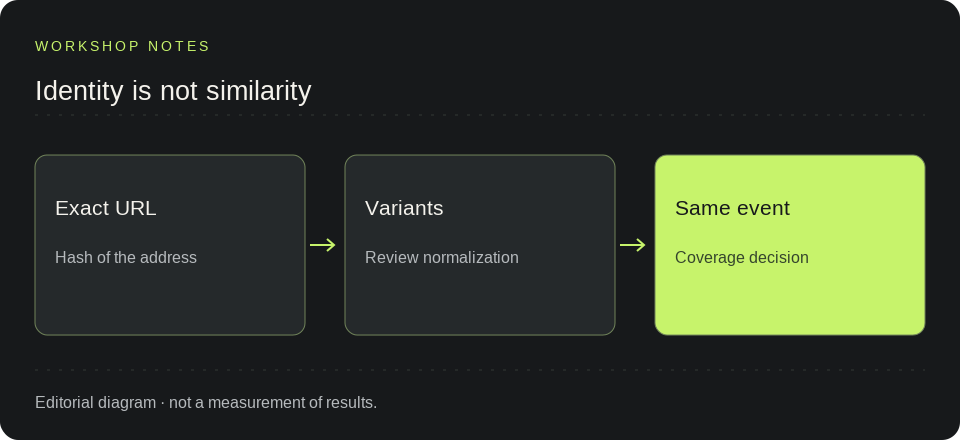
In the reviewed content creation path, the service calculates SHA-256 from the original URL and checks for a record with that identifier.
The field name may suggest a hash of the complete content, but the input here is the address. I need to inspect what is hashed before interpreting the result.
This detects that exact URL when it arrives again. It does not compare paragraphs or establish whether a story contains new information.
A link can change without changing the page
Tracking parameters, address variants and redirects can produce different strings. Different hash inputs no longer represent the same exact identity.
Scraping records also store a canonical URL. That provides a reference, but storing the field does not establish consistent normalization across every ingestion path.
I do not want to describe a universal canonicalization policy without checking it end to end. Normalization needs explicit rules and examples of what can be combined without losing meaning.
Similar texts can contribute different information
A press release reproduced by several outlets may look duplicated. A similar headline may also contain an update or additional source.
Evaluating that needs more signals: origin, date, title and available content. A URL hash alone cannot answer it.
Keeping several sources may also serve Radar’s purpose. Before removing them, I need to decide whether I want one item per event or a record of its coverage. Those are different products.
Count duplicates without overpromising
Collection jobs report new items, duplicates and errors. That helps observe an execution under its implemented rules.
I would not automatically interpret it as a measurement of repeated stories across all outlets. Understanding the number requires knowing which condition increased the counter.
A useful metric name also means not asking the value to explain something outside its scope.
Prepare cases before extending the rule
I would review repeated identical URLs, parameter variants, updates on the same page and different outlets describing one event.
I would record the expected result before changing implementation. That separates a faulty comparison from an editorial decision I have not made yet.
These are proposed evaluation scenarios, not a new deduplication campaign run against production data for this article.
Keep what I need to explain later
I want to avoid unnecessary records without erasing provenance. The right rule depends on what I want to explore later.
This series began with capture versus publication, continued with classification evidence and ends with stored identity. Across those cases, automating a comparison still requires defining what its result means.
AN IDEA TO SHARE