
A story can mention a place, party or person without meaning what a single matched word might suggest.
Radar needs to organize information for later exploration. Classification helps, but an unexplained label can imply a relationship the text does not support.
I want to retain evidence of each match and distinguish the entity being sought.
One word can refer to different things
Tlaxcala can mean the state or its capital. Finding the name alone is insufficient to assign the municipality automatically.
The classifier includes contextual patterns for that ambiguity. References to a city council or the city differ from references to the state government.
There are also shortened municipality names and party aliases. These are domain decisions about meaning, not merely string operations.
Know where the match appeared
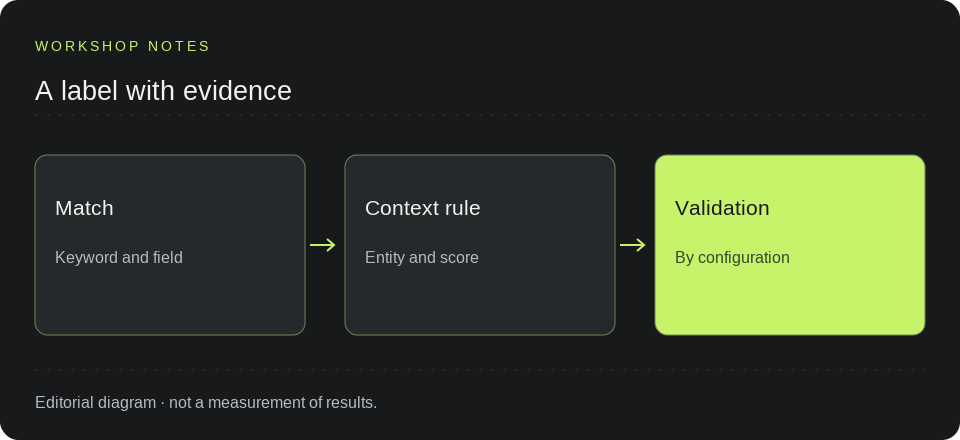
Results retain information such as the matched keyword and whether it appeared in the title, summary or excerpt where applicable.
That lets me return to evidence. When classification looks unusual, I can ask which field produced it instead of only seeing a final label.
Match location also influences scoring. A title reference and an isolated excerpt word do not necessarily receive the same treatment.
Scores do not all mean the same thing
In the reviewed code, topics and tags use additive scoring across matches. Actors, municipalities and parties retain another calculation based on presence in the title and summary.
I should not compare those values as equivalent percentages. An internal score is not a calibrated probability of correctness.
Thresholds make sense within their rule and entity type. Changing a rule also requires reviewing decisions that depend on it.
Detection and validation are separate steps
An editorial setting can automatically validate mentions meeting defined thresholds. That does not turn every match into automatic publication of the content.
I want these responsibilities distinct: finding a relationship, validating it and deciding which content to publish. Parts can be automated, but each state needs a clear meaning.
A historical sample also should not become a claim about current accuracy. Establishing results would require a defined evaluation and examples reviewed under consistent criteria.
Review errors that teach something
For a review, I would prepare ambiguous mentions, incomplete names and references in different fields. I would retain false positives and relationships the system missed.
The useful question is why an error happened and which other classifications a correction might affect. Adding a keyword can fix one example while creating another problem.
This article describes rules present in the code, not a new evaluation of production news.
Be able to explain a label
I do not expect keyword lists to interpret every story on their own. I do want classification that can be inspected and corrected without starting over.
Retaining fields, matches and rules gives me a way to follow that discussion. Organizing information also means being able to explain why it was organized that way.
AN IDEA TO SHARE