Collecting news in one place solves part of the problem. The next question is what to do with what arrived.
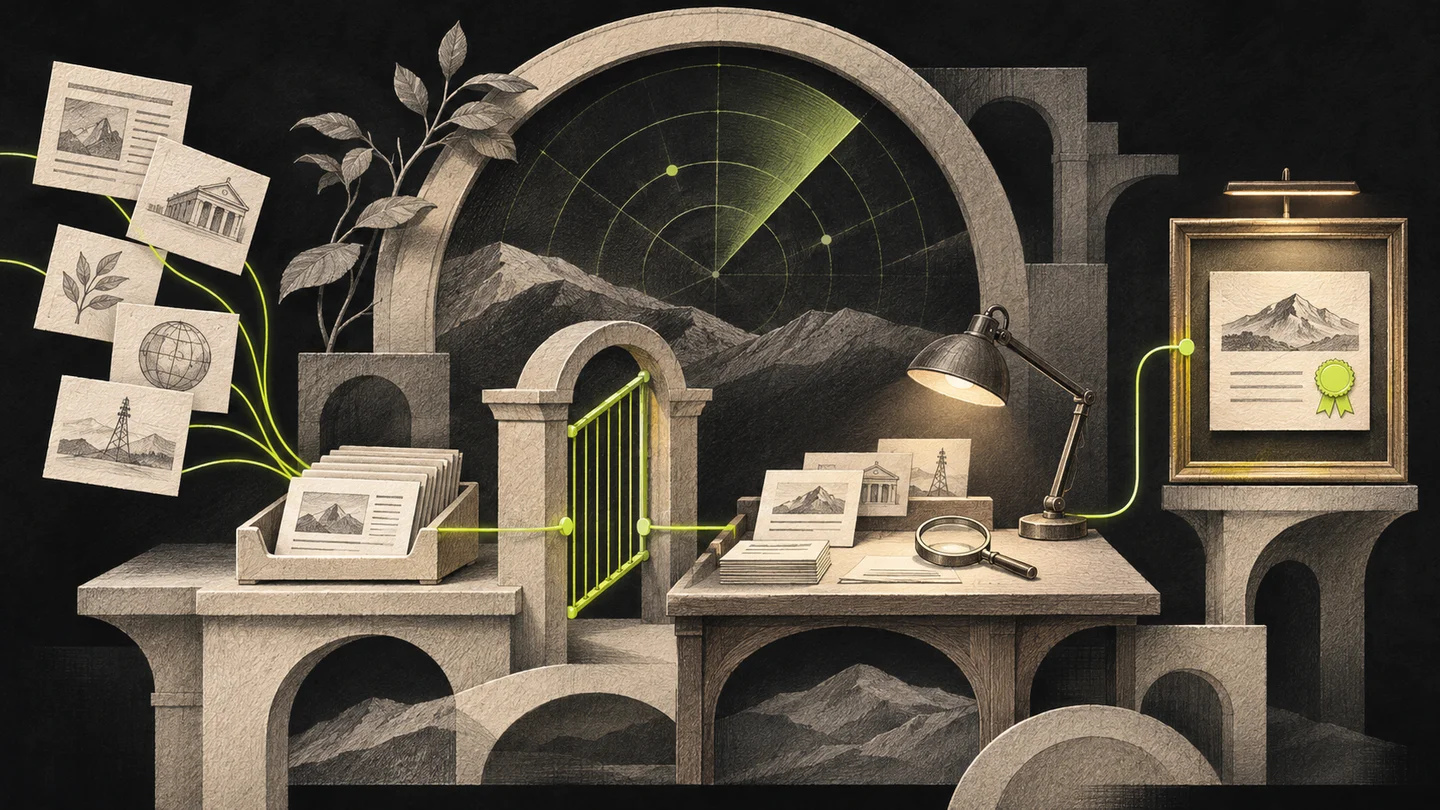
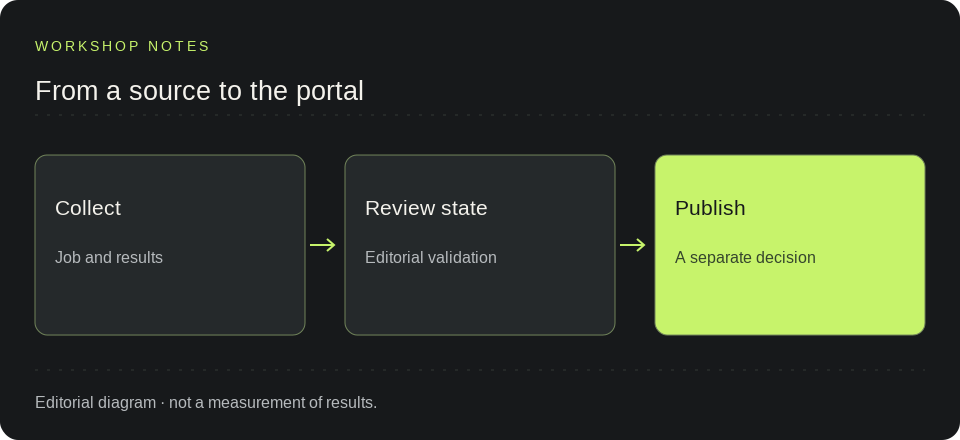
In Radar, I need to distinguish a queried source, stored content and a piece ready to appear on the portal. Mixing those moments can make a successful execution look like editorial approval.
I separate collection work from the content lifecycle. This entry describes that distinction in the implementation I reviewed.
Give an execution its own record
The scraper claims jobs through the API. Each has a mode and source: some retrieve recent RSS items, while others recover historical content within a date range.
Execution reports progress. Completion records counts of new items, duplicates and errors. A failed job also records its failure state and message.
These records explain the process. A count of new rows does not tell me whether each piece is ready to publish.
Content follows another path
The content service defines state transitions, including pending review, under review, validated and published, as well as rejected, hidden and archived states.
In the reviewed manual creation path, content starts pending review. It then needs the appropriate transitions. Existing in the database should not be confused with being visible.
I am not claiming every review is always manual: automation settings exist elsewhere in the system. The distinction here is between capture and the editorial state that determines the next step.
Historical recovery differs from checking recent items
Incremental collection and historical discovery answer different questions. One looks at recent items; the other needs a range and may discover many more addresses.
The worker distinguishes those modes and reports outcomes. Range processing also handles cancellation. That gives the panel more to communicate than a button displaying “loading.”
An execution can save some content while reporting errors. Its statistics matter as well as its final status.
Keep a way to explain what happened
When something is absent from the portal, I need to locate the cause. Did the source fail? Was the content already present? Is it awaiting review? Was it hidden afterwards?
Separating job records from editorial states makes those questions concrete. It does not prevent every error, but provides places to observe them.
To check the flow, I would try a failing source, a job finding nothing new and a piece moving through validation and publication. These are review scenarios, not audit results produced for this entry.
Automate without hiding decisions
I want to automate collection because repeating it manually consumes attention. Automation still needs to show what it resolved and what remains pending.
A technically successful response does not make content editorially correct. Keeping that distinction lets me grow Radar without treating everything found as ready for display.
The Radar project page provides an overview. This series focuses on decisions behind that process.
AN IDEA TO SHARE