
When a page looks right in my browser, I still have a question: what arrived before client code completed the screen?
For an article or news portal, I want predictable delivery of the main content. That affects reading, discoverable links and error inspection.
This is not only a framework choice. The same technology can produce very different route outputs.
Inspect the response before the DOM
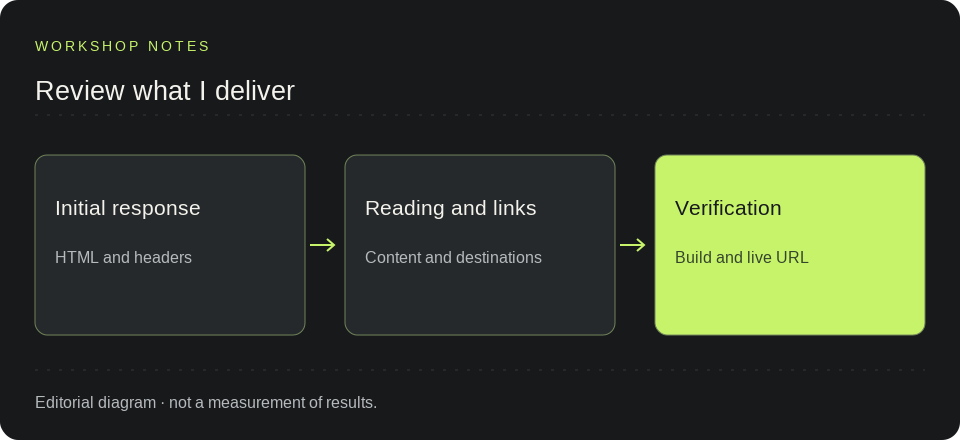
The inspector shows the document after client modifications. To review initial delivery, I inspect the document response in Network or download it.
This is a proposed check against an example domain, not a production result:
curl -sS -D headers.txt https://example.com/en/articles/my-entry/ -o page.htmlI would inspect the HTTP status, title, main content and navigation links, then compare them with the rendered DOM to see what JavaScript added.
Google can process JavaScript. Its official guide distinguishes crawling, rendering and indexing. Delivering initial content reduces dependencies; it does not establish that client-rendered applications cannot be indexed.
Let the document explain its subject
I want a specific title, an honest description and headings that organize reading. This illustrates the intention:
<title>Organizing an ingestion queue | Journal</title>
<meta name="description" content="Separating capture, review and publication in a news system.">
<main>
  <article>
    <h1>Organizing an ingestion queue</h1>
    <h2>Which work enters the queue</h2>
    <p>...</p>
  </article>
</main>
The fragment is illustrative. Adding tags is insufficient: visible content needs to fulfil the title’s intention. I would not treat a description as a promise that search results will display that exact wording.
Keep links as links
To reach another page, I use a link with a real destination. Buttons serve actions; opening a story need not depend solely on a click handler.
That supports opening new tabs and inspecting site destinations. A local audit can follow these links and detect missing pages or fragments.
Link context matters too. “Read how ingestion works” conveys more than repeating “see more” across every card, while the design still guides the appropriate visible wording.
Preserve error states
A missing page should respond accordingly. Sending an error screen with HTTP 200 miscommunicates the server’s outcome.
I separate preview and production configuration as well. I would not rely on JavaScript to remove an initial noindex directive: Google’s documentation warns that the initial block may prevent processing the later change.
Both HTML and headers need checking. A correct tag cannot compensate for contradictory indexing headers.
Automate a baseline, observe the rest
Build checks can catch repeated titles, missing internal destinations and indexing instructions in generated files. Hosting status codes and headers need server requests. That provides regression protection, not proof of ranking.
Next I would inspect the deployed URL and its state in Search Console. AI can help interpret HTML or suggest cases; the evidence remains the actual response.
For me, technical SEO review starts by understanding what I deliver before assuming what others understand.
AN IDEA TO SHARE