
An address seems like a detail until someone saves, shares or links to it. Changing it then also affects an existing reference.
In a journal or catalog, I need to decide what identifies a page and which variants should not become parallel destinations by accident.
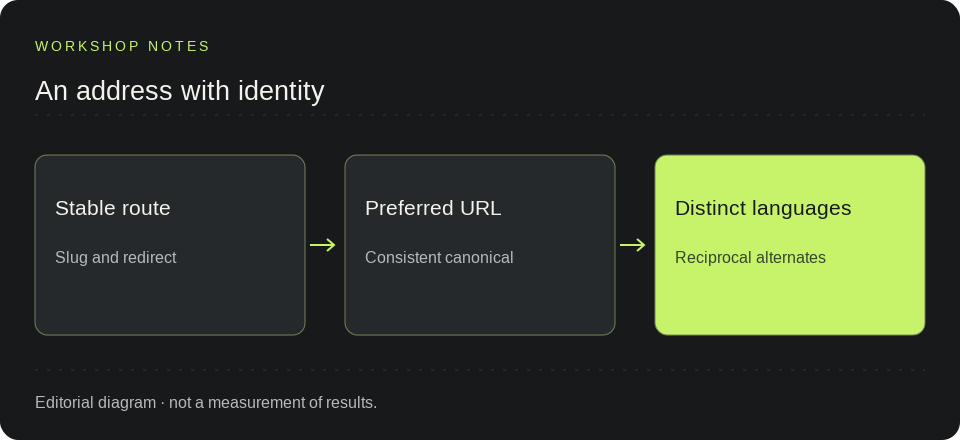
I separate four concerns: route naming, redirects, canonical URLs and languages.
Make slugs readable and reasonably stable
I prefer slugs that explain the subject, with separated words and no unnecessary internal identifiers. A small title edit does not require another URL.
If a published page moves, I prepare a redirect to its current destination and update internal links. Readers should have a route forward rather than reconstructing the address.
I do not present URL keywords as a shortcut to a Google ranking. Readability also helps maintenance and sharing.
Canonical is not a redirect
A redirect changes navigation’s destination. A canonical tag communicates a preference for the representative URL among duplicate or very similar pages.
Google Search Central describes that indication as a signal, not an instruction guaranteeing which URL will be selected. I therefore want links, sitemap and canonical to agree.
This illustrative page identifies itself as its preferred address:
<link rel="canonical" href="https://example.com/en/blog/ingestion-queues/">I would not use the tag to disguise a route that should have moved but remains available accidentally.
Languages retain their identity
A fully translated page has its own content and address. I would not automatically point every language’s canonical to Spanish simply because it is the primary language.
In this teaching example, the English page declares its canonical and both variants. The Spanish page needs the same alternate set and its own canonical:
<link rel="canonical" href="https://example.com/en/blog/queues/">
<link rel="alternate" hreflang="es" href="https://example.com/es/blog/colas/">
<link rel="alternate" hreflang="en" href="https://example.com/en/blog/queues/">
The localized versions documentation explains these relationships. I only announce equivalents that exist; translating navigation alone does not translate an article.
Decide what parameters represent
Tracking parameters differ from filters that change content. I would not strip all parameters from canonical URLs without inspecting the resulting page.
For each pattern, I would record whether it identifies different content, presentation or measurement. That helps avoid rules merging pages I intended to keep separate.
Trailing-slash variants and actual hosting redirects also need review. A development server does not establish another server’s behavior.
Check the complete route
For a moved page, I would inspect the original response, final destination and unnecessary redirect chains. Then I would compare internal links, sitemap, canonical and alternates at the destination.
Some checks can be automated. Google’s actual canonical selection requires indexing evidence; a passing build cannot establish it.
Treating URLs as architecture helps me care for the connection between content and people who already found a way to reach it.
AN IDEA TO SHARE